
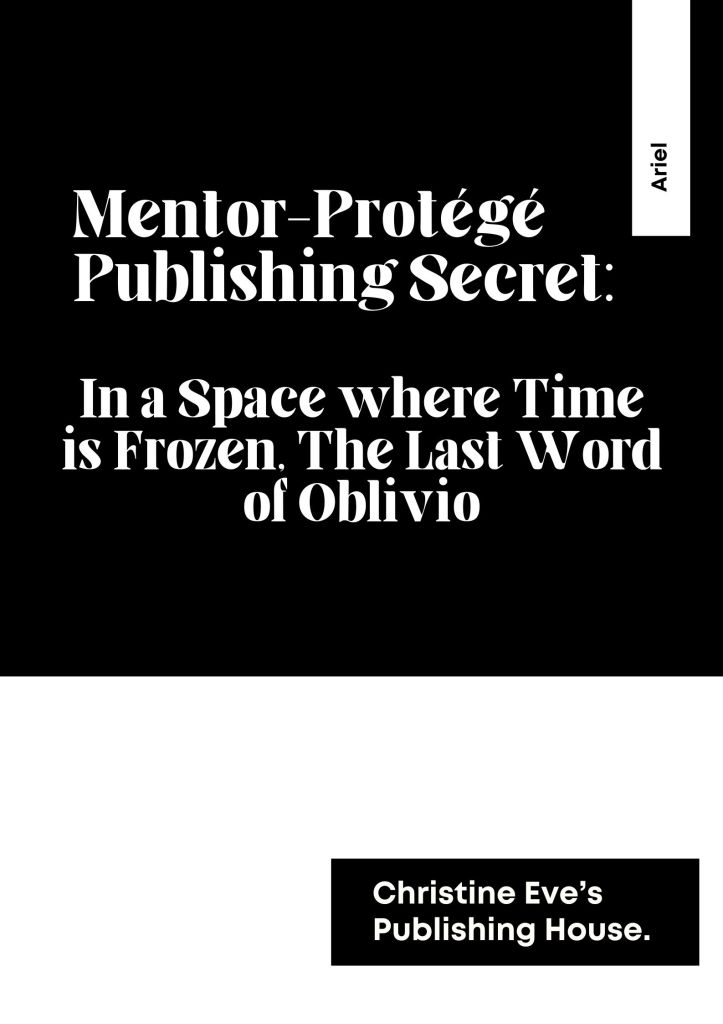
Writer: Ariel
Pen: Trinity Pen
Publishing House: Christine Eve’s Publishing House
IEU: 1
Ravel.5.8
Ariel, one day, watched a video on YouTube titled ‘Know Yourself’ from the comfort of her home. Curious about the speaker, Ariel searched to find the owner of the words and eventually discovered a figure named Socrates. Although there were various opinions about the origin of the quote, Socrates was a widely recognized name. Ariel became intrigued to learn everything about herself, starting with Socrates and then exploring contemporaries, philosophy, literature, and even recalling a movie about Stephen Hawking. As Ariel delved into various subjects, she felt a strange familiarity with certain concepts, even though she hadn’t formally studied them. She wondered if the ease of understanding came from the way teachers explained things. This led Ariel to ponder why people study and how she knew things without formally learning them. She explored astrology, reincarnation, and mysticism but, not finding resonance, turned back to books. Ariel revisited a comic book she had read before, transcribing its contents multiple times.
One day, the profound meaning of the text hit her, and tears flowed—a novel experience of emotions for Ariel. Following this, Ariel explored other languages, Biblical verses known to almost everyone, quotes from past philosophers and writers, and words from physics to construct sentences. She enjoyed the blend of science and philosophy but soon felt overwhelmed by the vast amount of knowledge. Ariel contemplated why people study, wondering if it was about easy explanations or if there was something more. She pondered the impossibility of reading all the books in the world within one’s lifetime.
One day, while reading articles on her phone, Ariel experienced a strange phenomenon—her screen enlarged, and letters appeared prominently. Intrigued, she followed the text, discovering websites about the universe and astronomy. Ariel felt as if the universe was gifting her with knowledge. Vibrations surged within her, and she heard voices, akin to tinnitus, accompanying the text. These experiences continued for days, with Ariel hardly sleeping, engaging in conversations with the voices. The voices guided Ariel through physics-related words like Hawking radiation, Riemann hypothesis, and other mathematical and physical terms. Despite being unable to interpret them, Ariel transcribed the words. Later, she bought related books but found herself unable to comprehend the content. Unsure if it was a call to study, Ariel focused on writing, creating a blog and social media accounts. Recently acquainted with MBTI, she began exploring her personality type, delving into psychology books and categorizing emotions, reason, and instincts. Separated elements and a single remaining existence caught Ariel’s attention. She decided to develop characters from the discarded parts and the remaining entity, intending to write a book. The characters underwent growth, and Ariel decided to use homophones for their names. She chose to write about their growth, inspired by the characters’ homophones. Having embraced the desire to do something no one else did, Ariel felt content.
Her journey led her to philosophical concepts, including the deaths of Socrates, Alan Turing’s suicide, and Stephen Hawking’s absence of a Nobel Prize. She pondered why she noticed such aspects and questioned whether studying one field required knowledge in others. In conclusion, Ariel decided that her desire to do something unique prompted her journey. Motivated by the idea of compensating for a missed Nobel Prize, Ariel committed to learning all necessary fields. Ariel’s novel, ‘Mentor-Protégé Publishing Secret: In a Space where Time is Frozen, The Last Word of Oblivio,’ featured a character named Christine, who, despite existing in the same reality, wrote novels with a different style.
Euclid View, an art edition book brand, presented Ariel’s novel alongside translated works of other protagonists through Hermes Dia. Euclid View contribute to growth. We want to help people create a better future through knowledge exchange and cooperation. Join us for growing and developing together. Euclid View has chosen to go back to the past, looking back at problems that have not been solved or proven so far. With the efforts and time of countless people in the past, you can experience research topics that have been going on for thousands of years in one place. We inform them that we are always grateful, that we reverently respect the hard work of past intellectuals as our responsibility to live the modern age and experience the pinnacle of technology, and that it is carried out to prove their achievements. Euclid View seeks research and innovation to solve problems in modern society. Euclid Views look back on the past and choose the way forward as people have had numerous efforts and time to solve unresolved or unproven problems in the past. The ability to access research topics that have been around for thousands of years in one place is possible thanks to the efforts of those who came ahead of us. We are always grateful to them, respecting their efforts and continuing to prove their work as a responsibility to experience the pinnacle of technology while living in the modern world. The setting explores a unique scenario where the real world intersects with the world within the novel. While Lily and Christine interpret and unravel theories, history, and scriptures recorded in reality, the narrative emphasizes the special experience of a novel being created within the novel.
Eve participates in Lily and Christine’s conversations by breathing life into them, providing various voices to add diverse perspectives to the story. Lily is characterized as a kind of unconscious entity, and Christine represents a character living in the reality within the novel. Eve, a character facilitating interaction among the characters, contributes unique dimensions to the dialogue by offering different perspectives through Lily’s voice. Christine Eve, unlike other characters, is the only one who can move directly. She listens to their conversations, finds patterns within, and presents works she personally designs to the world. Overall, the setting provides a unique experience where the boundaries between reality and imagination blur, and the character settings are crafted to have each character play a unique role, offering diverse perspectives to the story. Step into a realm where the lines between reality and imagination blur, experiencing a system analysis like never before – ‘Finery Mathematics and Effects Analysis.’ Each character plays a distinctive role, offering diverse perspectives that weave a captivating tapestry of this intricate tale. Don’t just read a story; live the adventure where the boundaries of fiction and reality intertwine.
Ariel has a day of 27 hours. Christine’s day is 24 hours. Christine Eve’s time is 9 hours. I want to become a winkle of you and be a part of your dream too.
The following is the story written by Christine Eve about Christine.
“The intention is to adapt this story into a movie, keeping that in mind while writing. The film begins with a black screen and the text, ‘Always present, interconnected, unpredictable before observation, and the moment one side is determined, the other is also decided.’ Following this, the text ‘The universe will bring you everything you desire! It’s right in front of you!’ appears, and the movie commences. As this text appears, the novel’s protagonist, Christine, comes into play. In a mundane scene, Christine starts reading a novel titled ‘Mentor-Protégé Publishing Secret: In a Space where Time is Frozen, The Last Word of Oblivio.’ Now, let’s dive into the content of the novel.
Reflecting on past experiences, Christine thinks about the movie, which depicts the story of Stephen Hawking and Alan Turing, who played Alan Turing on a separate screen from the actor who played Hawking. Christine imagines a film adaptation of her novel, in which the actor who played Alan Turing recreates the role and depicts Alan Turing and Stephen Hawking with a British wizard. Christine hopes her novel will be applied to the movie, with Turing, an American wizard, and the same actors who played Hawking, reprising their roles and rewatching the movie.
Christine wished that the female protagonist in the movie ‘Eclipse’ had taken on her role herself. She imagines the actors who portrayed Hawking and Turing in movies about their lives now acting in a movie based on her novel. Christine believes that for the book to be written, it has to be written in reality as well. While she writes the novel, the movie production must happen in a different dimension, beyond Christine reach. In the dimension where you are currently reading this book.
Through a recent movie where she noticed the actor who played the airplane man, whom she had seen in a movie when she was young, Christine once again encountered the airplane man. She also discovered that the director of this new film had directed a movie about Alan Turing. Christine wished that her film could be created by the director of Alan Turing’s movie and the actor who portrayed the airplane man. Christine hoped that he would play a role in Eve’s film, gathering geniuses, much like Oppenheimer. In a vast library filled with old typewriters and ancient manuscripts, representing the knowledge of the past. She wished for the actor who first caught Christine’s eye to become the final piece in Christine’s novel.
Christine pondered whether there was an actor who could take on the roles of Einstein and Richard Feynman, characters in her novel. Additionally, for her sister Lily’s Halloween Red story, Christine considered having the production team of Lily’s favorite movie, ‘Harry Potter and the Sorcerer’s Stone’ and ‘Harry Potter and the Chamber of Secrets,’ contribute. Lily’s Halloween Blue hoped for involvement from the director and production team of Guardians of the Galaxy, while Lily’s Halloween Navy wished for the director of TENET to be involved. This was because Lily’s Halloween Red story featured a boy in a wheelchair and a boy gazing at an apple tree. At that moment, Christine thought that the young Leonardo da Vinci looked just like the boy gazing at the apple tree. She wondered if it was true, or if it was a bit different but somewhat similar.
Christine envisioned a chess girl of the same age taking on Lily’s role. Lily symbolized the subconscious in the novel, representing the four protagonists through the imagery of red, blue, white, and finally, black dresses. The red dress symbolized Christine Eve, and Lily’s hair color turned white or silver when wearing the red dress. A light beige color close to white would also be suitable. The blue dress represented Christine, and Lily’s hair color turned white or silver when wearing the blue dress. Lily wore a black dress, symbolizing the subconscious, and her hair color turned white or silver. Finally, Eve wore a black dress, and her hair color was black.
Christine wanted to express the protagonists through Lily, imagining dresses in red, blue, and white. These dresses would be tank tops with dress lines exposed and flowing down to the ankles. Eve’s preferred style would be a tank top’s short mini dress, reaching about mid-thigh. The hair length for each of them would be daringly down to the waistline.
In an outdoor swimming pool where water is crashing like waves in a space of the universe, Eve immerses herself in the water, gazing up at the night sky and reaching out her hand towards the moon. In an instant, as she grabs it, the moon transforms into a diamond. The scene changes, and in slow motion, Christine Eve, in a red dress, walks down a long corridor. As she turns back to look at the camera, a voice says, “Don’t look back.” With that, Christine Eve turns her head forward again, flipping her long hair back, and her dress changes to blue as she continues down the same corridor. The actress remains the same, only the color of the dress changes as she walks.
As Christine Eve turns into Christine, somewhere a voice asks, “Am I human? Or am I a machine?” and another voice says, “Know yourself,” as Lily, with silver hair, wearing a black dress, continues down the corridor. As Lily passes, a scene with warm eyes of an actor portraying Stephen Hawking in a movie comes up, asking, “Can you hear me?” Then the face of the actor who played Stephen Hawking is shown in close-up, followed by a scene from another movie where the actor played a British magician. Next, Lily recalls a scene from her childhood of Harry Potter, where a car appears at the window to pick up the protagonist.
The scene returns to the corridor, where this time, Eve with black hair and a black dress opens a massive door and enters. Upon entering, Eve’s study, reminiscent of a grand library, is revealed. Eve goes to the window, pushing something aside like curtains on both sides, and when she holds up a diamond where the moon should be in the window, the diamond becomes the moon in the night sky. Suddenly, Eve’s eyes, which had been gazing at the moon, shine as if something has passed, leaving fragments of light, and she heads towards the moon. Even from the moon, Eve’s light sparkles. Drawn by a powerful force, as if by the background of the universe around the moon, she is swiftly pulled towards Christine on Earth, like an arrow. As she approaches Christine lying on the sofa, the screen creates a texture like fluttering transparent curtains, and through the texts on the phone screen that Christine is looking at, it recounts the events so far. Christine looks at her phone, and as these images enter her mind with sound, she feels small waves of a transparent texture settling inside her.
Christine had a thought while writing her novel. ‘The more I lose my sense of reality, it seems like you outside gain a sense of reality. As I become lighter, the weight I feel in my body gets heavier and heavier. It’s fascinating.’
Before long, another thought occurred to her, ‘Distinguishing us with big and small quotation marks is a brilliant idea! There’s nothing from Eve’s perspective, but there’s a spy. Lily. Lily can mimic our voices, you see. At that time, it’s not about the sound, but about seeing the emotion. Things Lily would never say, things she can’t say, things we can’t help but say.’
Anyway, Christine recalled the movie ‘Troy’ as the most memorable and impressive one and considered casting actors to play ancient Greek scholars. As she contemplated whether a modern setting or actors in modern clothes appearing in an ancient Greek background would be better, Christine, valuing the importance of actors the most, waited for the actors to become visible in her mind, even though they were not in her memories.
Contemplating the backdrop and the cast, Christine organized her thoughts. For the sake of realism, it would be great to express characters other than this one through CG! Christine wanted an actor who played a snake on the same screen as the British wizard to play her sister. However, Christine Eve remains unaware of her virtual existence and the fact that she’s a product of Christine’s imagination. Even if she were to discover this later in the story, Christine Eve would likely respond nonchalantly, saying, ‘Oh, really? Well, what’s the big deal? Just tell me what it is!’
Contemplating how to bring forth the time of ancient Greek individuals, Christine recalled a movie where a man realizes he’s living inside a screen. She wished the protagonist of that film, who played Socrates, would reprise the role. In a fast-paced sequence, she envisions the final scene of that movie crossing with the moment the actor portraying Socrates reads the inscription ‘Know Yourself’ on a column in an ancient Greek temple, just before drinking hemlock.
Christine discussed the contents of the novel she was writing with her brothers. Of course, it was a casual conversation for them. ‘No, seriously, what was the dog doing while setting the research journal on fire? I have to rewrite it! It’s driving me crazy. So, remember what happened in the next volume?’ Frustrated and angered, Christine often threw such questions at her older brother, and today was no exception. As a result, their relationship didn’t seem as smooth as that between Christine and her younger brother. While they continued their argument, the younger brother intervened, establishing himself between them. While sitting at a table in front of a cafe and chatting, Christine’s younger sister, Christine Eve, passed by, noticed them, and, with a line questioning what they were doing here, briefly engaged in conversation before mentioning that she was heading to a movie shoot. As she was about to leave, one of her brothers, who had been a magician in the UK, asked which movie she was going to appear in. Christine Eve replied that it was a movie featuring a British magician and then left. Watching Christine Eve leave, the brother who had been a magician in the UK looked at Christine, saying he felt like he had seen this scene somewhere. He added, “Or is it déjà vu?” Christine, with a smile, responded, “Really? Why is that?” and began asking her brother about RNA. Eventually, a voice from her childhood came to mind. “Get me out of here! I think I’m trapped!”
Christine came across fascinating videos on YouTube about Einstein and Stephen Hawking. In these videos, she learned that knowledge expands from Einstein and that after a person dies, their knowledge somehow returns to others from Hawking. It’s like a loop, from the past to the future. Is it the theory of the Big Bang? Knowledge is a metaphorical expression, and it probably involves quantum mechanics. Following a narrative as if connecting it, just like someone who wrote or spoke before, is intriguing. Although it might not be easily visible due to its small size, I knew that, much like the flickering screen on a television, things in reality remain right in front of us, even if we can’t see them clearly. However, it’s only recently that I realized they stay right there, visible, even when I open my eyes.
Always wished for an older brother, but having one was an impossible dream. Consequently, in her novel, she creates two fictional brothers. One is the tall brother, depicted by the boy gazing at an apple tree, and the other is the small brother, represented by the boy in a wheelchair. Christine arbitrarily decided their roles. In her mind, she generates a family she has never experienced before, becoming a deity in her own creation.
She establishes a friendship with the boy who built the Enigma machine. Christine wishes to have meaningful conversations with her newfound friend, lying in a vast garden resembling an apple tree orchard. In this place, the boy in the wheelchair is no longer confined, playing football and leading an ordinary college life. The boy who once looked at the apple tree is now eager to share knowledge with his younger sister, Christine. Despite Christine’s weakness in mathematics compared to her confidence in physics, she decides to study math with her new friend. Will you cheer for her? Absolutely, that’s a must!
While Christine explores potential directors for her movie, she stumbles upon a story about one who creates films based on theories. Remembering a phrase she had come across in the past, ‘If you reverse time, a singularity occurs,’ she contemplates, ‘If a director can create a film based on a theory, perhaps one could develop a theory after watching a film.’
Christine reflects, ‘Despite investing the most time and effort into the novel ‘Interdisciplinary Research,’ what becomes most evident is that Christine Eve is writing a novel where she herself is the protagonist.”
Christine’s inspiration to create fictional family and friends originated from reading a passage about Newton creating imaginary characters in his mind while writing about Newton. It served as a catalyst for her desire to try it herself, to mimic the process of getting ideas, getting inspired. It can be expressed as gaining an idea, finding inspiration.
Christine makes a solemn vow, ‘If I were you, you should be superior to the people of the past. It’s a courtesy to them. Their legacy when I was born is full and overflowing to see and follow anything.’
In Christine’s novel, the worldview involves interpreting general relativity as special relativity and understanding special relativity as general relativity. Christine’s setting revolves around studying general relativity and special relativity in reverse. -Christine Eve.
Cookie: Socrates drank hemlock. Really? Again? Alan Turing committed suicide.
A voice is heard on the black screen with subtitles. ‘Really? Again?’ is Christine’s voice.
 Church of René